By Nena Močnik, WP1 Lead
The first pilot implementation of SensArticulate, an affect-centred, arts-based methodology developed within the MAGnituDe project, invited experienced qualitative researchers from Sweden, Lithuania and Latvia to step outside their familiar research routines and explore how creative processes and non-verbal embodied expression could complement conventional qualitative methods across pilot studies conducted in Sweden, Lithuania and Latvia with Ukrainian forcibly displaced persons. As part of the project’s methodological work package (WP1), the pilots were designed to test, refine and critically evaluate the SensArticulate approach before its wider application across the consortium, examining not only what kinds of data it generated, but also how it transformed the research encounter itself. Although each team works in a different context and pursues different research questions within the MAGnituDe project, several common methodological observations emerged across all pilot sites.
“I allowed myself to be more… an observer”: From asking questions to learning to observe
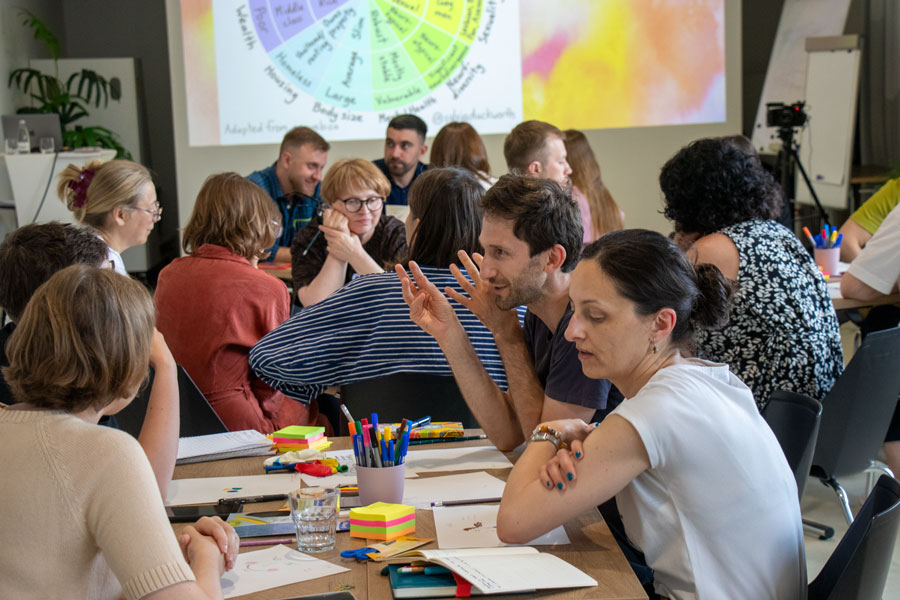
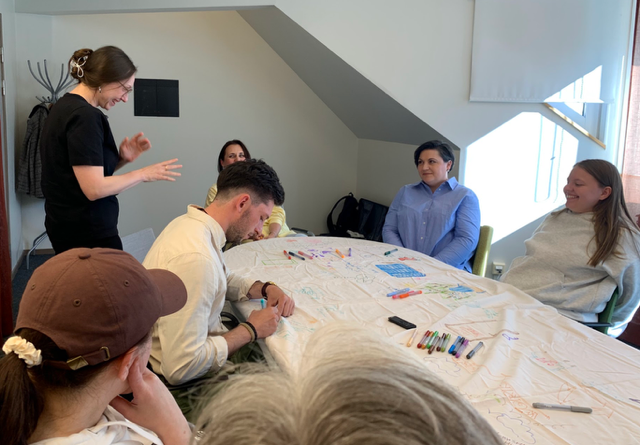
In interviews, researchers are constantly occupied with asking questions, listening actively, deciding when to probe further and guiding the conversation in the direction to get answers we anticipate are useful. During the SensArticulate workshops, many researchers found themselves doing something they rarely have time to do, as a researcher from the Swedish team described it, to “just observe”. Moving away from focusing on spoken responses, researchers described noticing more what was happening around them: for instance, how participants searched through magazines, how they leaned towards one another to peek on selected materials, and how they were fully immersed in the creative process. For some this was often challenging, as they admitted to resist the familiar urge to intervene: one researcher reflected that, while participants were creating their collages, she found herself wondering whether asking additional questions might actually interrupt an important process rather than enrich it. Observing the non-verbal is one of the core ideas of SensArticulate, and for the researchers, the pilot became a lesson in adopting a different research posture that is based less on directing, targeted conversation and more on witnessing, observing, and simply being present.
Rethinking Silence in the Research Process
Silence has long intrigued qualitative researchers, yet it remains one of the least understood elements of the research encounter. It is often treated as a pause to be interpreted, overcome or minimised, while methodological guidance on how to approach silence as data remains limited. The SensArticulate pilots invited researchers to reconsider this assumption. During the workshops, silence became one of the richest moments of the research process, as researchers repeatedly described the atmosphere during the creative process as peaceful, concentrated and deeply reflective. In qualitative research on trauma, silence may signal discomfort and like this, prompting researchers to react, and to move on to the next question. Observing participants fully immersed in selecting images, arranging compositions and reflecting on their experiences, one researcher from the Lithuanian team described silence that occurred as “cozy”. Silence, in this process, became a space for inner reflection, as participants searched for visual symbols and metaphors to express thoughts, memories and emotions – perhaps replacing the gap left by “missing words.” For several researchers, this raised an important methodological question: when they observe silence as a carrier of inner reflections and accompanying emotions, not simply marking the space between responses, how can we capture and interpret this better, without overly imposing meanings to it?
“Images trigger something which rationally you do not think before”
Across all three pilot sites, researchers concluded that the workshops did not produce more data than interviews, but different ones. “People were picking pictures…” explains one researcher from the Lithuanian team, “which probably you wouldn’t refer to during a classical interview,” and with this confirming a broader observation across the pilots that selected images revealed themes a conventional interview might never have elicited.
One participant used a picture of Christmas to explain that this tradition symbolised that Lithuania began to feel like home; the researcher commented:
Maybe you wouldn’t think about the Christmas tree when you talk during the interview, but here you find this picture…
Another participant used dark colours to represent her early experience of displacement, but in her creative expression, dark colours gradually transformed into brighter ones. In Sweden, participants collectively transformed drawings of closed doors, piles of paperwork and bureaucratic barriers by adding keys, alternative entrances and wheels, to portray obstacles and imagine the solutions to them together rather than merely describing them. Ordinary, everyday objects symbolized and metaphorically explained complex concepts such as identity, belonging, bureaucracy, uncertainty and hope. Researchers repeatedly emphasised that these visual narratives did not replace verbal testimony, but complemented it by revealing emotional, symbolic and embodied dimensions that traditional interviews alone may not have captured.
The group became part of the methodology
Researchers were also surprised how quickly trust emerged among participants: when exchanging magazines and passing materials around the table, this caused some clumsy situations and comments, made them laugh together, and started to create internal ‘jokes’, to the point that some participants started exchanging phone numbers after the workshop. One researcher from the Swedish team observed,
I didn’t expect that the group will work as some kind of mechanism.
Another reflected that the workshop gave participants something that interviews rarely can:
In the interview they describe their experiences. In the workshop they realised they shared similar struggles… they could also support each other.
However, in this process, the researcher is not left alone with emotions raised during the interview, or doesn’t carry a burden to protect participants. Everyone involved manages difficult emotions together; participants respond to each other with empathy, humour and encouragement, and the group itself, including researcher(s), became a source of support. Researchers observe the thin line between therapeutic process and SensArticulate methods, when reporting on mutual respect, and atmosphere that in a natural way offered a space for vulnerability, connection and mutual recognition. As SensArticulate is not designed as a therapeutic intervention, future training will need to address how researchers can maintain research integrity and ethical boundaries while recognising and responsibly navigating the therapeutic effects that may naturally arise.
A different balance of power
The atypical relationship between research participants and a researcher brings forward also a question of power: unlike interviews, where questions inevitably shape the direction of responses, SensArticulate allows participants greater freedom to decide what matters, how they wish to represent it and when they want to speak. Researchers from Lithuania reported that in SensArticulate, “the participants have more agency” and researchers become more like facilitators of a shared process, where participants craft their own stories with minimal intervention. With such a changed dynamic, a degree of methodological trust is required, whereby researchers trust participants, trust the process, and remain willing to adapt the anticipated direction of inquiry in response to what emerges during the research encounter.
Looking ahead
For the majority of the researchers involved, using SensArticulate was a first experience of conducting research in a different way – and where they became facilitators of the process rather than researchers directing it. Coming from traditions of interviews, focus groups and qualitative fieldwork, uncertainty was not unfamiliar to the researchers—it is, after all, an inherent part of qualitative inquiry. In this case, however, the uncertainty was shaped by anticipation: how would participants who had lived through traumatic experiences perceive the methods, engage with the creative processes, and experience the workshops? By the end of the pilots, that scepticism had disappeared, but not because of the belief that SensArticulate could replace conventional qualitative methods, but because they experienced how it opened different ways of observing, understanding and interpreting lived experience.
When we think about methodological innovation, we often begin by asking what new research tools we should develop or how we might refine existing ones. The first round of piloting, however, suggests that methodological innovation may begin elsewhere: by changing how researchers themselves learn to see, listen and remain present in the research encounter, and by asking what kinds of data remain invisible simply because of how—and where—we have learned to look. As the MAGnituDe project enters its next round of piloting, it will be equally important to explore whether these reflections hold across new contexts, participants and methods, and what further methodological questions and possibilities emerge along the way.