For years, research has been framed as the accumulation of words, metrics, numbers, and citations; and knowledge reduced to what can be measured, coded, or neatly stored in documents. But what if the insights we need to drive meaningful social change aren’t just about what we can understand, but also about what we can feel?
That question sparked the idea for SensArticulate, a living experiment that merges sensory (sens-) and artistic (art-) expression (-articulate). It strived to be a somewhat methodological rebellion; a space where familiar practices of research would transcend the confines of speech, text, and analysis. But what began as a training in Ljubljana in July 2025 quickly evolved into something deeper: an exploration of the shared vulnerability of venturing into places we rarely go, our feelings, the memory, and experiences stored in our bodies. What brought us together is our shared research interest in how traumatic experiences shape the lives of war-displaced people, and our drive to uncover the knowledge beneath the silence, emerging when the worlds fail us.
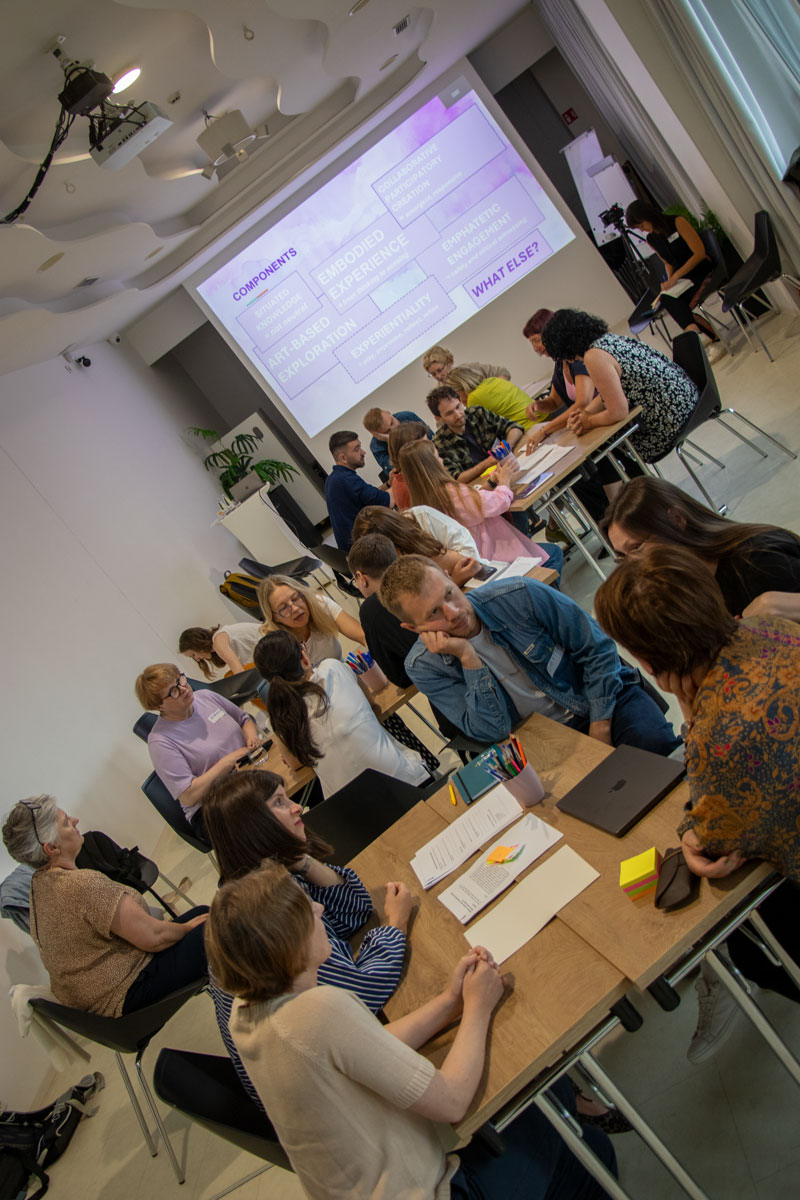
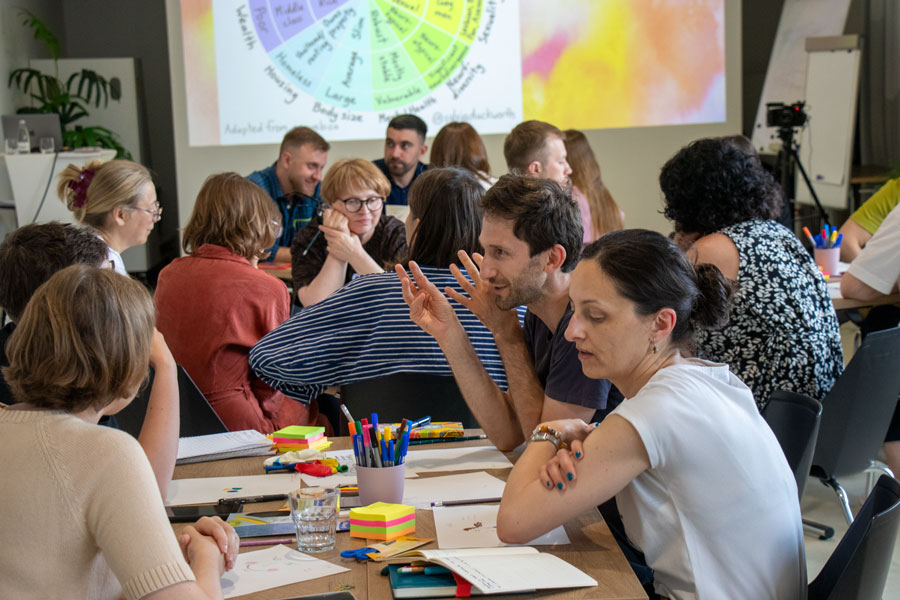
During three July days in Ljubljana, we explored sense- and art-: touch in movement; hearing in sound, sight in collage and photography. Those tools became not add-ons but as a new language of knowing, and as such, causing a subtle discomfort among participants, many of whom were engaging creatively and bodily for the very first time. Instead of observing others, we turned inward: toward our own bodies, emotions, and positionalities. For once, we became what we so often study: the subjects of our own inquiry.
The idea behind SensArticulate is simple, though not entirely new. The literature we drew on as a theoretical foundation earlier this year, reveals a long and rich tradition of interdisciplinary creativity in methodological approach in research of collective trauma across non-clinical fields. Yet, despite this abundance, mainstream science in Western academia remains stubbornly verbal, linear, and extractive. Stories must still be told, transcribed, and analysed to count as a legitimate academic output.
For the MAGnituDe project, exploring such alternative pathways is essential. When we study forced displacement and trauma, particularly in contexts of war such as the full-scale Russian invasion of Ukraine, stories and responses often dwell in silence, tension, gesture, and withdrawal. Often they express through the body, not the logically structured sentences, and which rather stays unrecognized in daily interactions with SLBs and the host community. Most researchers, however, are not trained to read this language or to translate embodied silence into meaningful scientific data.
By engaging non-verbal, non-linear, and arts-based approaches, SensArticulate aims to explore those cues not as the background noise that ends up in parenthesis transcripts. We are searching to explore how non-verbal embodied signals can become valid data with epistemic value.
In our exploratory lab we touched upon these unspeakable dimensions of knowledge and embodied modes of perception through artistic practices, led by the experienced team of APIS trainers. The training was co-designed by Nena Močnik from Pompeu Fabra University, Barcelona, and the Apis Institute, Ljubljana, which has long been exploring the intersections of art, research, and social inclusion. It was facilitated by Močnik, an academic, researcher, and trauma expert, as well as an experienced facilitator of trainings based on non-formal learning methods. Her approach created a bridge between academic inquiry and embodied, arts-based exploration, grounding the experimental methods in both rigor and empathy.
Under the guidance of Romana Zajec, director of the Apis Institute, each trainer drew on their experience of using creative and embodied methods with marginalized or vulnerable groups and translated these practices to make them suitable and adaptable for research contexts.
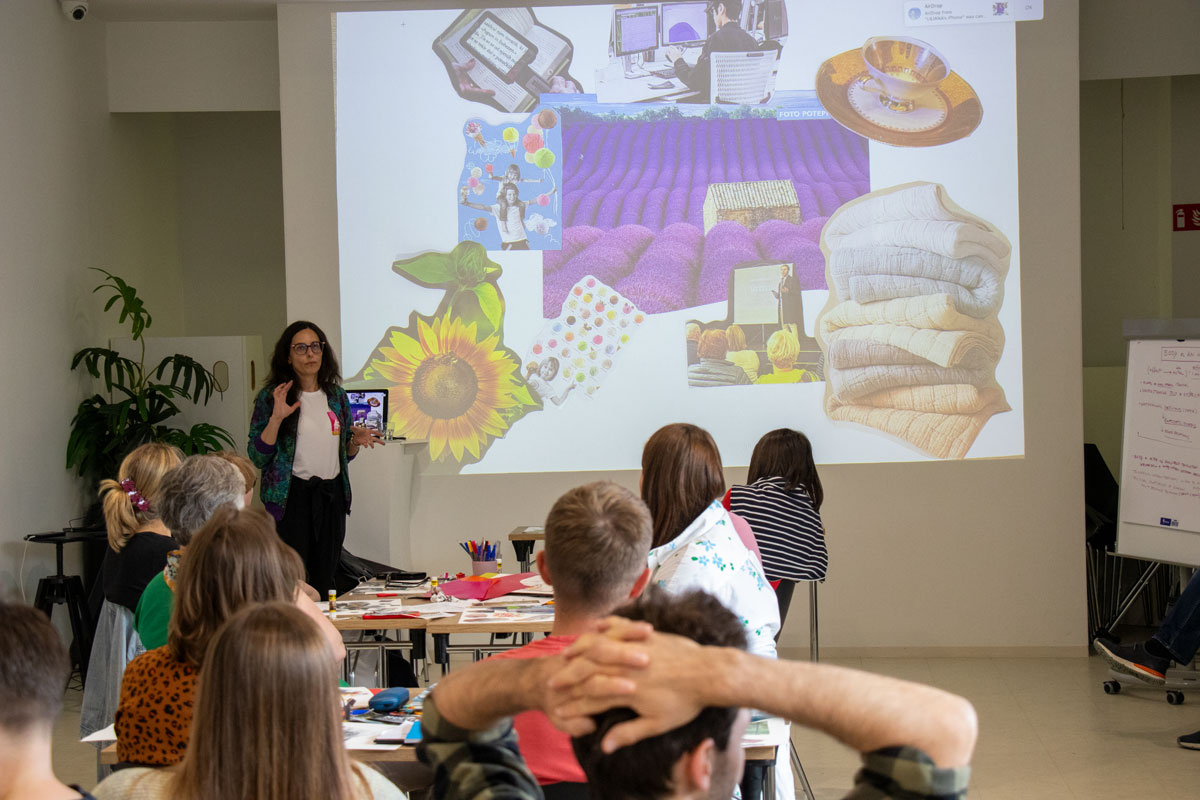
Hana Alhadi led grounding movement practices; Ali R Taha introduced sound and humor as ways of reframing emotion; Luka Dakskobler transformed photography into emotional cartography; and Liliana Mascio guided collage work as a form of reassembling fragmented selves.
Each approach offered a new entry point for data collection and an opportunity for researchers to question their own interpretive authority and relational presence. Together, we began to ask how such, still too often unconventional forms of embodied intelligence might be interpreted, and what capturing such data and transforming it to knowledge demands from us epistemologically, methodologically, and ethically. These practices do more than add a creative layer to research as they destabilize hierarchies of what counts as credible knowledge. They affirm the multiplicity of human expression and invite us to recognize participants not merely as sources of data but as co-creators of meaning.
Something vital was born in Ljubljana. As we collectively selected and adapted existing tools for use in fieldwork across several European countries, we also reflected on how such methods are received institutionally. Unfortunately, these approaches are still often marginalized, or, at best, treated as extras, and rarely recognized as crucial, central sources of knowledge. However, the challenge is bigger: as SensArticulate aims to embody a slower, more relational research culture that resists academic acceleration and hyper-production, sustaining it in the long run will require more than enthusiasm for innovation. It will demand genuine institutional support and recognition. And with this, the Ljubljana lab revealed also, that what we need are not only new methods, but new ways of being researchers, and with this advocating for a reorientation of research values toward mutual vulnerability, embodied knowledge, relational ethics.